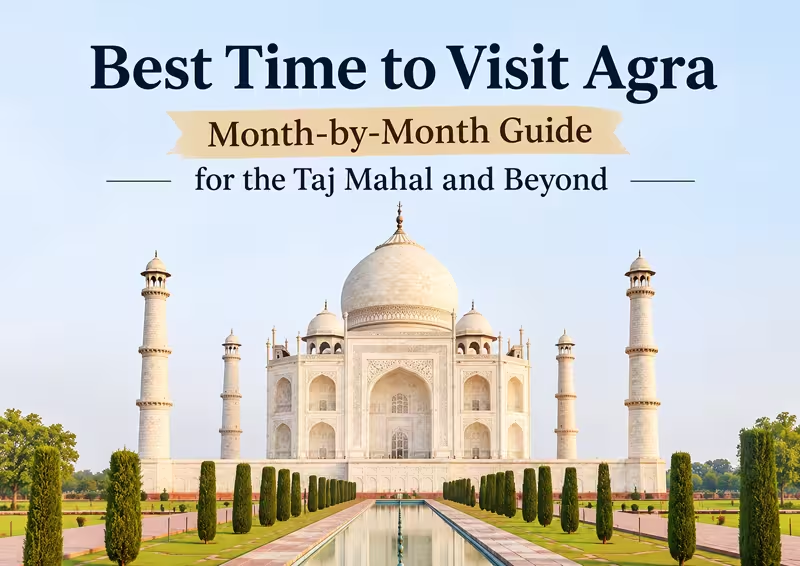
The short answer is October to March. The longer answer depends on what you care about most: comfortable weather, clear photos, thin crowds or low prices. You rarely get all four in the same month.
We arrange trips to Agra all year round, so we have seen the Taj Mahal in thick winter fog, in 44°C heat and in the middle of the monsoon. Here is what each season is really like, so you can pick the one that suits you.
Quick answer
• Best overall: mid-November to mid-February, for cool days and comfortable sightseeing.
• Best for fewer crowds and lower prices: early October or late March.
• Best for photography: late October to early December and February, when the haze and fog are usually lighter than in peak winter.
• Hardest months: May and June, when daytime temperatures often cross 40°C.
Agra weather by season
Winter (November to February)
Days are mild, usually around 20 to 25°C, and nights can fall close to 5°C. This is the most comfortable time to walk around the Taj Mahal, Agra Fort and Fatehpur Sikri, all of which involve a lot of time on open stone.
The catch is fog. In December and January it can sit over the city until mid-morning, and the Taj can look like a faint outline at sunrise. Fog also causes train and flight delays, so avoid tight connections on those days. Hotel prices and crowds are highest around Christmas and New Year.
Our advice: if you visit in December or January, don’t plan sunrise as your only Taj visit. Keep a second slot in the afternoon in case the morning is lost to fog.
Spring (late February to March)
This is our favourite stretch. Temperatures climb gently into the high 20s and low 30s, the fog is mostly gone, and the crowds ease after the winter rush. February often includes the Taj Mahotsav, a ten-day crafts and culture festival near the Taj. Dates vary each year, so check before you plan around it. Holi falls in March and is lively but noisy and messy, so expect some roads and sites to be busy.
Summer (April to June)
Expect 38 to 45°C by midday, with hot winds. Sightseeing is still possible, but only early in the morning and late in the afternoon. The red sandstone at Agra Fort and Fatehpur Sikri holds heat and can be uncomfortable underfoot.
The upside is cheaper hotels and thin crowds. If you must travel in summer, start at opening time, rest through midday, and carry water, a hat and a light cotton scarf.
Monsoon (July to September)
The monsoon brings humidity, patchy rain and green lawns around the Taj. Showers are often short, and the skies can look dramatic. Crowds are smaller and hotel rates are lower. Rain does make surfaces slippery, and heavy downpours or flooded roads can interrupt a day trip.
Post-monsoon (October)
The heat breaks and the air clears. October can be a sweet spot, with moderate temperatures and fewer visitors than November. Around Diwali, air quality in north India can dip, so check the forecast and carry a mask if you are sensitive.
Month-by-Month Guide: Weather, Tourist Crowds and Travel Tips in India
| Month | Weather | Crowds | Travel Notes |
|---|---|---|---|
| January | Cold with foggy mornings | High | Fog can delay flights and road journeys. Keep a flexible time slot for your Taj Mahal visit. |
| February | Mild and gradually clearing | Medium to High | Pleasant for sightseeing. The Taj Mahotsav in Agra usually takes place during this month. |
| March | Warm and generally pleasant | Medium | Holi celebrations offer a cultural experience. Good conditions for photography. |
| April | Hot and increasingly dry | Low | Plan monument visits early in the morning and late afternoon. |
| May | Very hot | Low | One of the toughest months for sightseeing. Stay hydrated and limit midday outdoor activities. |
| June | Very hot, with increasing humidity towards the end | Low | Pre-monsoon conditions can bring occasional showers. Schedule a midday rest. |
| July | Humid with frequent rain | Low | Gardens and landscapes turn greener. Expect cloudy skies and possible travel delays. |
| August | Humid and rainy | Low | Check road conditions and weather forecasts before long drives. |
| September | Warm, with gradually decreasing rainfall | Low to Medium | The monsoon begins to withdraw, although showers may continue. |
| October | Warm with generally clearer skies | Medium | Good photography conditions. Diwali celebrations may bring local haze and increased activity. |
| November | Pleasant and comfortable | High | The main tourist season begins. Book hotels and transport in advance. |
| December | Cool with foggy mornings | Very High | Peak travel season, higher hotel prices and possible fog-related delays in Delhi and Agra. |
Check live forecasts and the IMD website before you travel; conditions shift from year to year.
Choosing the best time of day
- Sunrise is the classic choice. The marble changes colour as the light rises and the crowd is thinner, though it is still busy in peak season. In fog it can be a disappointment.
- Late afternoon is a good alternative. The queue is shorter, and the glow before sunset is lovely. You can combine it with Mehtab Bagh, the garden across the Yamuna, for a view of the Taj from the far bank.
- Full moon nights are offered on a limited basis. The ASI allows small groups on the night of the full moon and for a couple of nights either side, excluding Fridays and the month of Ramadan. Tickets are limited and booked a day in advance, so check the ASI site for the current rules.
Know before you go
- The Taj Mahal is closed on Fridays to general visitors. Plan your Agra day around that.
- Tickets: buy from the official ASI channels and avoid street sellers. Fees differ for Indian and foreign visitors and change, so confirm on the ASI site.
- Security: bags are checked. Leave large bags, tripods and food at the hotel.
- Allow time: the Taj needs about two hours, Agra Fort another two, and Fatehpur Sikri two to three more.
Which month suits you?
- First-time visitors who want the classic experience: November to February, with the caution about fog.
- Photographers: late October, early December and February.
- Budget travellers: late March, early October, or the monsoon if you can accept some rain.
- Families with young children: avoid April to June. Choose November or February.
Travellers with limited mobility: choose the cooler months and a private car with a driver, so you avoid long waits in the sun.
Plan your trip
Agra is rarely a stand-alone stop. Here is how our guests often build it:
- Short on time? Our Delhi to Agra same-day tour covers the Taj Mahal and Agra Fort with a private car and driver.
- Want more history? Read our Fatehpur Sikri guide, and see how it fits into a day from Agra.
- Building a longer route? The Golden Triangle tour: Delhi, Agra, Jaipur is our most popular itinerary.
- Need only transport? Explore our car rental services for comfortable and convenient travel across India, with flexible vehicle options to suit your journey.
- Want a personalised travel experience? Contact our team to plan a customised North India itinerary tailored to your travel preferences, schedule and budget.
Frequently asked questions
What is the best month to visit Agra?
November to February offers the most comfortable weather, and February to March is a good balance of mild temperatures and lighter crowds.
Is it worth visiting Agra in summer?
Yes, if you manage the heat. Go early, rest at midday and keep your itinerary short.
Can I see the Taj Mahal in the rain?
Yes. Rain keeps crowds down and the gardens look fresh, but showers can slow things and make the stone slippery.
How many days do I need in Agra?
One full day covers the Taj Mahal and Agra Fort. Add a second day for Fatehpur Sikri, Mehtab Bagh and a slower pace.
Is the Taj Mahal open every day?
No. It is closed on Fridays. Check the ASI site for any changes.
Final thoughts
There is no single perfect month for Agra, only a best match for your priorities. If you want the safest bet, aim for November or February. If you want space to yourself and don’t mind the heat or the rain, you can have a very good trip outside the peak months. Whatever you choose, book early for the Taj Mahal, avoid Fridays and leave room in your plan for the unexpected.
Not sure which dates suit you? Contact our team and we will help you choose.
By Harshit Agarwal
Harshit Agarwal is a travel writer at Budget India Tours. He writes about India’s popular destinations, cultural heritage, travel itineraries and practical travel tips, helping travellers plan memorable holidays across India.